Hair Extensions for Fine Hair in London: The Best Methods for Natural Volume and Length
An honest, clinical guide to adding safe, lightweight volume and thickness to delicate or thin hair. Written by certified London extension specialists Mădălina & Cornelia.
If you have fine, thin, or delicate hair, you have probably been told at least once that hair extensions "aren't for you"—or worse, you have spent hours worrying that adding extra hair will leave your natural locks damaged, broken, and patchy.
At Sisters Hair Extensions, we hear this exact concern during client consultations every single week at our East London studio. Many women with fine hair struggle to achieve density, hold a blow-dry, or grow past a certain length without their ends looking wispy and transparent. Yet, because fine hair is naturally more fragile and has less density to conceal heavy bonds, traditional one-size-fits-all extension methods can cause tension, visibility issues, and follicle stress if applied incorrectly.
The truth is simple: you can safely wear hair extensions with fine hair, provided the method, strand weight, and placement geometry are custom-calibrated specifically for delicate hair. In this in-depth guide, we break down the science of fine hair, analyze why keratin bond hair extensions and tape-in hair extensions are the two best methods for fine hair, and share the exact techniques we use to achieve discreet, weightless, and natural-looking volume without compromising your natural hair health.
Can You Get Hair Extensions with Fine Hair?
Yes, you can absolutely wear hair extensions if you have fine hair. In fact, clients with fine hair often experience the most dramatic, confidence-boosting transformations because even a conservative application (such as 50g to 75g of hair) can double the visual thickness of your natural ponytail and eliminate stringy ends.
Common Misconceptions About Extensions on Fine Hair
- "Extensions always cause traction alopecia and bald patches": Traction alopecia only happens when the weight of the extension strand is significantly heavier than what the natural supporting root hairs can bear, or when installed with excessive tension. When fitted strand-by-strand with custom micro-bonds, the weight is distributed safely across healthy root sections.
- "The attachment points will always be visible": With standard clip-ins or bulky sew-in weaves, attachments can easily show through thin hair layers. However, when working with mini keratin capsules or slimline tape-in tabs placed strategically below your natural crown fall, the attachments remain completely invisible even in breezy London weather.
- "You must add 200g of long hair for extensions to be worth it": On fine hair, less is almost always more. Adding 150g+ of heavy 24-inch extensions to fine hair is a recipe for root fatigue. Instead, adding 50g–100g of volume-focused extensions cut to your natural length (or 2–4 inches beyond) creates bouncy, realistic thickness.
When Fine Hair Is Suitable for Extensions
Fine hair is an ideal candidate for professional extensions if:
- Your hair is naturally fine in diameter (baby-soft, silky texture) but has stable, healthy roots.
- You have normal scalp health with no active, unmanaged scalp dermatitis or sudden active shedding.
- Your natural hair has sufficient length (at least 4 to 5 inches across the crown) to veil the attachment row.
- You are committed to gentle daily aftercare and scheduled maintenance visits.
When Hair Extensions Are Not Recommended
As ethical specialists, we believe in honesty first. We will advise against extensions (or suggest waiting) in the following scenarios:
- Active telogen effluvium or postpartum shedding: If your hair is currently shedding in large handfuls due to hormonal fluctuations, illness, or acute stress, your roots cannot anchor extensions safely.
- Severe chemical breakage at the root: Hair that has snapped off close to the scalp from over-bleaching requires a restorative treatment regimen before considering extensions.
- Trichotillomania or severe scalp sensitivity: Any condition involving active scalp inflammation or pulling impulses requires medical guidance rather than hair attachments.
This is why a detailed, in-person consultation is non-negotiable. If you are unsure whether your hair is ready, you can book a free consultation with us to have your scalp and follicle strength evaluated in person.
What Makes Fine Hair Different?
To understand why certain hair extension techniques succeed while others fail, it is essential to distinguish between hair density and hair strand diameter. Many people confuse the two, yet they dictate entirely different placement rules.
Key Distinction: Hair Density vs. Hair Strand Thickness
Hair Strand Thickness (Diameter): Refers to the physical width of an individual hair fiber (fine, medium, or coarse). Fine hair has a narrower cortex and often lacks a medulla, making each individual strand silky, delicate, and prone to bending.
Hair Density: Refers to the total number of individual strands growing per square centimeter of your scalp (low, medium, or high density). You can have fine hair with high density (lots of tiny strands), or fine hair with low density (thin, sparse strands).
The Volume Challenges of Fine Hair
Fine hair naturally lies close to the scalp. Because individual strands have less structural rigidity, they produce minimal natural lift and struggle to hold a curl or wave for extended periods. Furthermore, fine hair absorbs sebum rapidly, which can cause the roots to look flat and separate within 24 hours of washing.
Why Attachment Choice Matters for Fine and Thin Hair
Every attachment method exerts a specific physical load on your hair. Heavy sew-in weaves, bulky micro-rings with silicone beads, and rigid machine-weft tracks require a dense anchor base. If installed on fine hair, the weight of the heavy track pulls constantly on the delicate roots, leading to breakage, follicle strain, and visible bulges through the hair.
For fine hair, the attachment must satisfy three essential criteria:
- Weight-to-Base Ratio: The extension strand must never exceed the weight of the natural supporting section.
- 360-Degree Movement: The attachment must flow in the natural direction of root growth rather than bending against it.
- Minimal Flat Surface Area: The connection point must lie completely flush against the curve of the cranium.
Best Hair Extensions for Fine Hair
Through years of specialist salon experience in London, we have tested and refined every extension method on the market. For fine and thin hair, two methods stand above all others: Keratin Bond Hair Extensions and Tape-In Hair Extensions.
Keratin Bond Hair Extensions for Fine Hair
Also known as fusion bonds or hot fusion extensions, keratin bond hair extensions are the gold standard for clients with fine or thin hair who want the ultimate in discreet, 360-degree freedom.
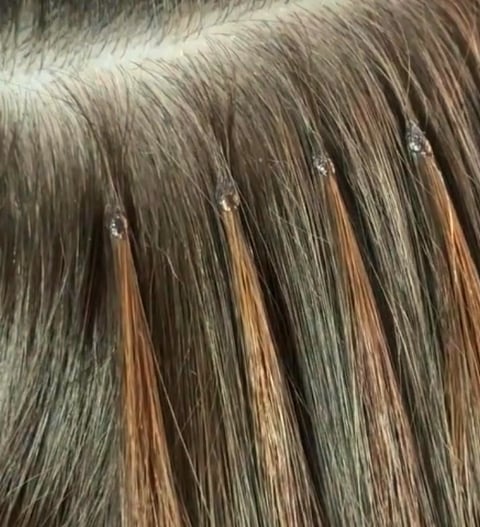
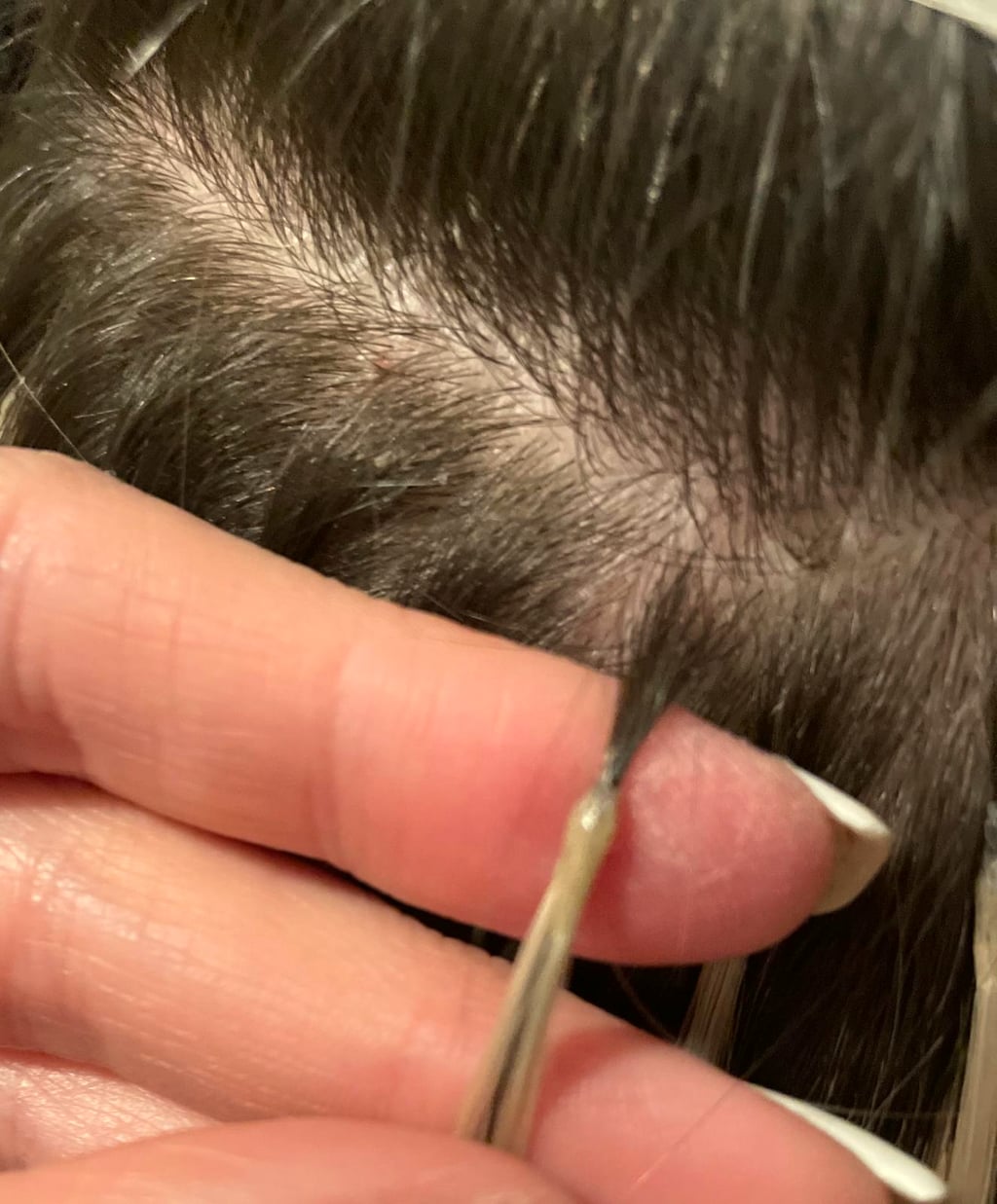
Keratin is the natural protein that makes up 90% of your own hair. In this method, individual extension strands tipped with premium Italian keratin are fused to small, precise sections of your natural hair using a controlled, gentle acoustic heat tool. The softened keratin is rolled into a tiny, rice-grain-sized seal that hardens into a lightweight, flexible bond.
Key Benefits for Fine Hair:
- Unmatched Discretion: For fine hair, we custom-cut standard bonds into mini bonds (0.5g) and micro bonds (0.3g). These tiny bonds blend completely with fine strands and remain undetected even when the wind blows.
- Lightweight, Strand-by-Strand Customisation: Because we apply the hair strand by strand, we match the exact density of your natural hair section to the extension strand. There is zero heavy pulling.
- Full 360-Degree Movement: Unlike wefts or rigid tapes that lie horizontally, keratin bonds swivel freely with your natural hair fall. This allows fine-haired clients to wear high ponytails, messy top knots, and parted updos with complete confidence.
- Long-Lasting Freedom: Once fitted, keratin bonds stay securely in place for 3 to 4 months before a routine salon review, allowing your natural hair to rest from heat styling and grow undisturbed.
Tape-In Hair Extensions for Fine Hair
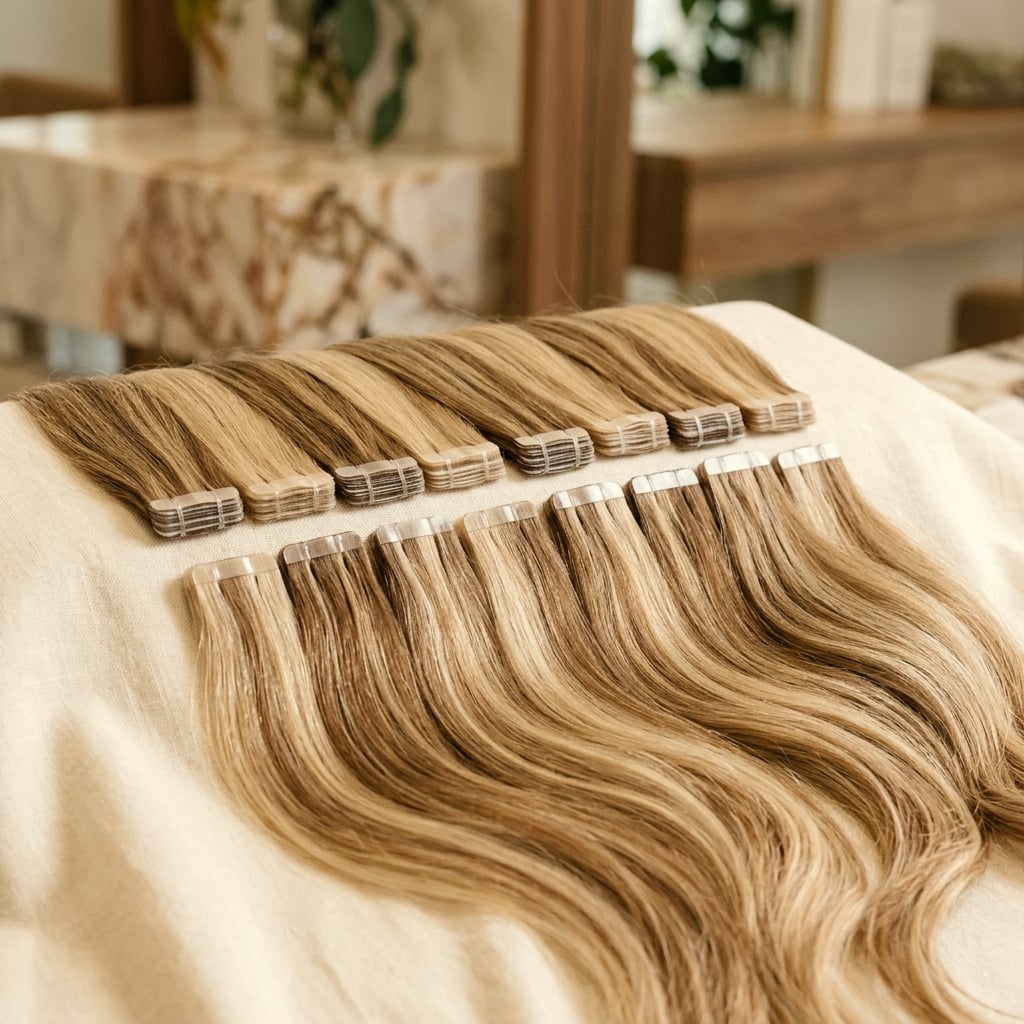
Tape-in hair extensions are pre-taped wefts of hair measuring roughly 4cm wide that are applied by sandwiching a thin slice of your natural hair between two medical-grade adhesive strips.
For fine hair, tape-ins offer an exceptionally gentle and fast way to build instant horizontal volume, particularly along the sides and back perimeter where fine hair often looks sparse.
Key Benefits for Fine Hair:
- Rapid, Gentle Fitting: A full volume fitting takes just 60 to 90 minutes, making it ideal for clients with busy London schedules who want instant density without a 4-hour chair session.
- Completely Flat Profile: The tape tabs are paper-thin and lie directly against the scalp, creating no bulky bumps or ridges under delicate crown layers.
- Even Weight Distribution: Because the extension hair is spread across a 4cm width, the weight is distributed across hundreds of individual hairs simultaneously, preventing concentrated pinpoint root tension.
- Gentle Reusability: Tape-ins are maintained every 6 to 8 weeks by sliding them out with an organic alcohol/oil solvent, washing the natural hair, applying fresh hypoallergenic tape, and reapplying the same premium hair.
Keratin Bonds vs Tape-Ins for Fine Hair
Both methods deliver beautiful, natural-looking results, but choosing between them depends on your hair density, styling habits, and maintenance preferences. Here is our direct clinical comparison for fine hair:
| Feature | Keratin Bonds (Mini/Micro) | Tape-In Extensions |
|---|---|---|
| Visibility in Fine Hair | Virtually invisible; micro-bonds can be placed closer to the parting and hairline. | Ultra-flat; invisible under medium layers, but requires adequate hair cover at the crown. |
| Longevity on Fine Hair | 3–4 months of continuous wear before removal or refitting. | 6–8 weeks before routine repositioning and tape replacement. |
| Maintenance Schedule | Low daily maintenance; brush with loop brush, wash 2–3x weekly. | Regular refits required every 6–8 weeks as roots grow out. |
| Styling Flexibility (Updos) | Maximum flexibility (360° rotation for high ponytails and buns). | Great for low ponytails, waves, and half-up styles; high buns require mindful placement. |
| Best Fine Hair Profile | Thin to fine hair, sparse density, patchy areas, active lifestyle. | Fine hair needing quick perimeter density, blunt cut enhancement, budget-conscious. |
| Application Duration | 3 to 5 hours (handcrafted precision fitting). | 1 to 2 hours (fast application). |
| Cost Structure | Higher initial application investment; longer wear cycles. | Lower initial fitting cost; more frequent refit appointments. |
For a detailed breakdown of longevity and salon costs across all methods, explore our dedicated keratin bonds vs tape-ins method comparison guide.
How We Match Extensions to Fine Hair
Fine hair allows zero margin for error. In thicker hair textures, a slight mismatch in density, color undertone, or bond weight can be hidden under heavy natural layers. In fine hair, every single strand is visible.
At Sisters Hair Extensions, our fine hair fitting protocol consists of a rigorous 5-step assessment:
1. Root Density Mapping
During your first hair extension consultation, we physically examine your scalp in sections. We assess your density zones—identifying where your natural hair is thickest (usually the occipital bone at the back) and where it is naturally more delicate (the temples, parietal ridge, and crown).
2. Micro-Bond Sizing and Weight Calibration
We do not use pre-packaged, heavy commercial bundles. We hand-customise each keratin tip or tape placement. For very fine hair, we cut standard 1g bonds in half (0.5g mini bonds) or thirds (0.3g micro bonds) so the weight of the extension strand perfectly mirrors the holding capacity of your natural hair.
3. Multi-Tonal Colour Matching
Fine hair is naturally translucent under bright light. If extensions are matched using only a single solid shade, they can look artificial and blocky. We blend two to three complementary tones (matching your root shadow, mid-length dimension, and sun-kissed ends) to create realistic visual depth that makes your natural hair appear twice as thick.
4. Lifestyle & Habit Assessment
We consider your daily routine. Do you tie your hair up for frequent gym sessions? Do you wash your hair daily? Do you swim often? Your answers help us determine whether keratin bonds or tape-ins will integrate seamlessly into your life without causing unnecessary friction.
5. Strategic Perimeter Planning
We leave a generous "safe margin" around your natural hairline, ears, and crown parting. This ensures that when you tie your hair back or when the wind blows on your morning London commute, no bonds or tape corners peek through.
How to Protect Fine Hair While Wearing Extensions
Wearing extensions on fine hair should always be a protective, hair-enhancing experience. Following a structured aftercare routine ensures your natural hair grows healthy and strong underneath.
1. Brushing Technique for Fine Hair
Never use standard paddle brushes with hard plastic balls on the tips, as they can catch on the bonds and pull fine root hairs out. Use a professional extension brush with soft, flexible boar and nylon bristles (such as a loop brush). Always hold the roots of your hair with one hand to support the bonds, and gently brush from the ends upward.
2. Washing and Drying Routine
- Use Sulphate-Free & Silicone-Free Shampoo: Sulphates dry out extension hair, while heavy silicones or conditioning oils can break down tape adhesive and soften keratin seals.
- Condition Mid-Lengths and Ends Only: Never apply conditioner, serums, or hair oils directly over the root area or bonds.
- Never Sleep with Wet Extensions: Fine hair is at its weakest when wet. Always blow-dry your root attachment area thoroughly on a cool-to-medium heat setting.
3. Nighttime Care & Friction Reduction
Friction between fine hair and cotton pillowcases causes tangling and matting at the roots. Before bed, loosely gather your hair into a soft braid or low ponytail secured with a silk scrunchie, and sleep on a 100% mulberry silk pillowcase to eliminate friction.
4. Adhere to Scheduled Maintenance Appointments
As your natural hair grows, the extensions move downward away from the scalp. On fine hair, allowing extensions to grow out beyond their recommended maintenance cycle causes the hair to twist and increases levered tension on the root follicle. Stick strictly to your 6–8 week tape refits and 3–4 month keratin maintenance reviews.
For our comprehensive step-by-step product recommendations and maintenance guides, read our dedicated aftercare services overview and our complete hair extension aftercare handbook.
Hair Extensions for Fine Hair: Frequently Asked Questions
Frequently Asked Questions on Fine Hair Extensions
Will hair extensions damage fine hair?
No, provided they are fitted correctly by a fine hair specialist and properly maintained. Damage on fine hair is almost always caused by overweight bonds, excessive tension, placing extensions too close to the scalp, or improper removal. When individual strand weight is customised 1:1 to your natural hair density, extensions protect your natural hair and allow it to grow safely underneath.
Are keratin bonds safe for fine hair?
Yes, mini and micro keratin bond extensions are widely considered the gold standard for fine and thin hair. Because the keratin tips can be trimmed down to custom mini sizes (0.5g–0.6g per strand), they place minimal tension on fragile roots and distribute weight evenly across individual hair groupings.
Are tape-ins visible in thin hair?
Standard tape-ins can sometimes show if your crown or parietal ridge has very sparse density. However, when placed strategically in areas with adequate natural hair coverage—or when paired with ultra-slim invisible micro-tapes placed below the crown—they lie completely flat against the head and remain undetectable.
How long do extensions last on fine hair?
On fine hair, keratin bonds last between 3 to 4 months before needing a routine maintenance check or refit (with the premium hair itself reusable for up to 9–18 months depending on your care). Tape-ins require refitting and re-taping every 6 to 8 weeks as fine natural hair grows out to prevent the wefts from twisting.
Can I tie my hair up with extensions if I have fine hair?
Yes! During your consultation and application, we leave a strategic 1.5 to 2-inch 'safety perimeter' around your entire hairline, temples, and the nape of your neck. This ensures you can wear high ponytails, messy buns, and half-up styles without any attachments showing.
Which method gives the most volume to thin hair?
Both methods provide incredible volume, but they deliver it differently. Tape-ins create fast, broad horizontal density across the mid-lengths and ends, making them great for blunt bobs and medium-density fine hair. Keratin bonds offer 360-degree targeted placement, allowing us to fill in specific thin spots around the crown and sides for the most natural, seamless volume.
Why Clients Across East London Choose Sisters Hair Extensions
Founded and operated by sisters Mădălina and Cornelia, Sisters Hair Extensions has earned a reputation as London's premier boutique destination for delicate, fine, and difficult-to-match hair. Unlike large commercial salons where fittings are rushed on assembly-line schedules, we dedicate focused, one-on-one attention to every client, ensuring your hair health is never compromised for rapid turnaround times.
From our welcoming studio in Dagenham, we regularly welcome clients seeking natural-looking hair extensions for fine hair from across East London and Essex, including:
Romford
Clients travel to us for bespoke keratin bond volume fills that blend effortlessly with natural fine textures.
Barking
Fast, discreet tape-in applications designed to give instant thickness to fine, post-colour treated hair.
Ilford
Specialist multi-tonal colour matching for clients wanting multi-dimensional volume without bleach damage.
Hornchurch
Gentle micro-keratin fittings tailored for fine, wedding-ready and special event transformations.
Stratford
Convenient transport connections for busy professionals seeking low-maintenance volume solutions.
Book a Hair Extensions Consultation for Fine Hair
Ready to experience natural, weightless volume without risking your hair health? Book a free, no-obligation consultation with Mădălina & Cornelia. We will assess your natural hair, match your custom shade, and design a bespoke extension plan tailored to your hair type, lifestyle, and goals.